TPMS Light On After a Wheel or Tire Service? What It Means
November 2, 2026 · AZ Rim Repair, Mesa AZ
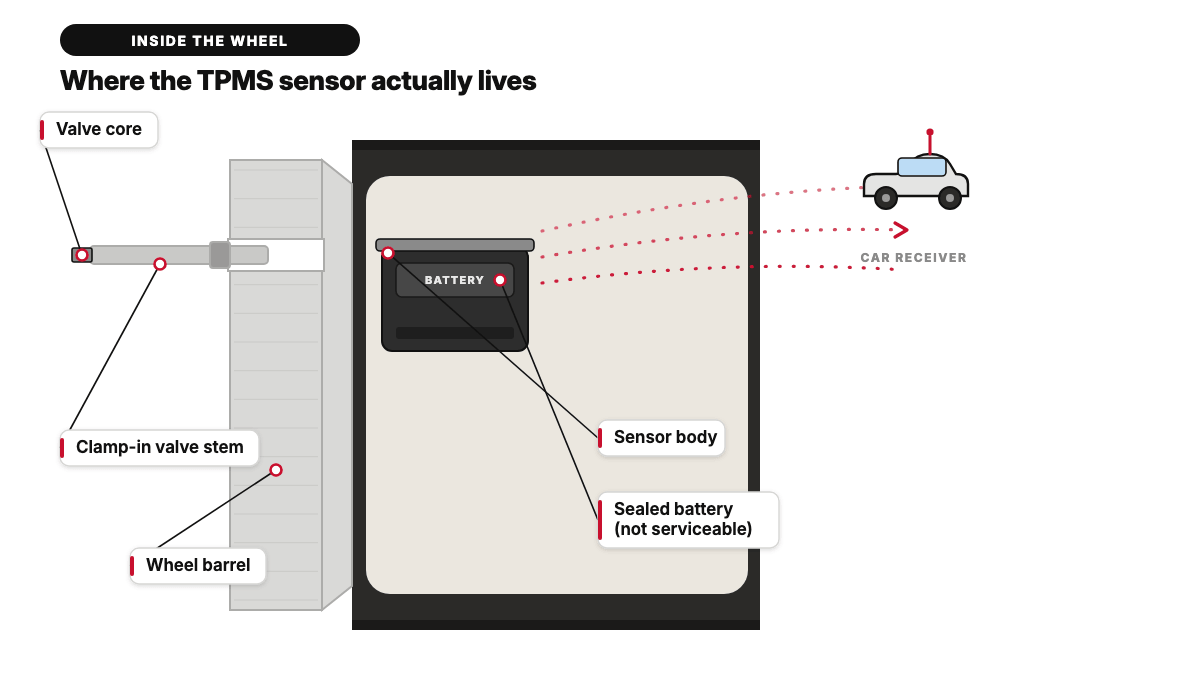
You picked up your wheels from a repair, or drove off with new tires, and the dash is now showing the TPMS light — the little horseshoe with an exclamation mark. It is not a scam and it is usually not an emergency. In almost every case it is one of four things: a pressure that was set wrong, a relearn the car still wants, a sensor or its valve stem that got disturbed on the tire machine, or a sealed battery that picked this exact week to die. This guide walks each one, in the order a shop would check them, and tells you which you can fix in the driveway and which needs a scan tool.
The short answer
Read the light before anything else. A TPMS warning that comes on SOLID means the system sees low pressure in at least one tire — check all four with a gauge against the number on the driver's door placard. A light that FLASHES for about a minute and then goes solid means a system fault: usually a sensor that has failed or a battery that died. After tire or wheel service, the solid light is by far the most common, and pressure or a relearn fixes most of those. If the pressures are right and the light keeps coming back, someone needs to scan the system — and if the wheel is already coming to us for a crack weld or straighten, that is the cheap moment to have the sensor looked at, because the tire is already off.
Read the light first: solid or flashing
The icon is the same either way, but the two patterns mean completely different things, and the split is a convention every TPMS-equipped car follows. Solid: at least one tire is below the pressure the car expects — that is a tire problem, and a $10 gauge answers it in two minutes. Flashing for roughly 60 seconds at key-on, then solid: the system itself is reporting a fault — a sensor that is not answering, a dead sensor battery, or a receiver problem. That is not a tire problem, and airing the tires up will not clear it. Check the pressures anyway, because a genuine slow leak and a failing sensor can look identical from the driver's seat.
Why the light shows up right after wheel or tire work
Four causes, in the order of likelihood. First, pressure: tires get set at the shop, temperatures drop at night, and the threshold is tight — a tire that was fine at 5 PM can trip the light at 6 AM. Second, the relearn: on many cars, the TPMS control unit needs to be told which sensor ID lives at which corner after a tire rotation, a replacement, or any work that moved sensors between positions. Until that relearn runs, the car can show a fault or a phantom pressure. Tire Rack's TPMS technical page covers which manufacturers require it and the different procedures involved. Third, physical damage: the sensor on most cars is mounted to the valve stem from inside the wheel, which makes the stem area the exact spot a tire machine's lever pushes. An aged, corroded clamp-in stem can crack or snap at demount — the tire comes off fine, and nobody sees the damage until the light comes on. Fourth, coincidence that is not coincidence: sensor batteries are sealed in at manufacture with a service life measured in years — commonly around a decade — so a sensor that was already near the end can die the week the wheel was in the shop. It was going to fail that month either way.
Where the sensor actually lives
On most passenger vehicles the TPMS sensor is a small sealed unit fastened to the inboard end of the valve stem, inside the tire, with the stem doubling as its antenna and mount. That design is why tire work and sensor problems overlap: every dismount passes the tire iron near the sensor, and every mount seats the bead around it. It is also why alloy wheels with old stems deserve new service parts when the tire is already off — the labor is the same; only the parts change.
One related warning from the tire side: canned tire sealant. The rubber-string-and-goop route is for emergencies, and sealant inside a wheel coats the sensor, the stem, and the barrel — proper tire repair demounts the tire and patches from the inside, as the U.S. Tire Manufacturers Association describes. Our shop's published policy says the same thing in dollars: canned sealant left inside a wheel carries a $50 cleanup fee, because someone has to clean it off everything — sensor included.
Is it the sensor, the stem, or just air?
Work it in order. Gauge all four tires cold, including the spare if it is a full-size TPMS-equipped one, and compare them to the door placard — not the tire's max-psi sidewall number, a mistake the tire care essentials guide calls out. Fill anything low, drive a few minutes, and see whether the light clears. If the pressures are correct and the light is still solid, look up the relearn: many owners' manuals describe a do-it-yourself procedure that takes ten minutes and no tools. If the light flashes at start-up, the relearn will not fix it — that is the scan-tool case. A shop scan tool polls each sensor directly and reads its ID, its reported pressure, and its battery state, which turns "the light is on" into "left-rear sensor, battery at end of life" in about a minute. Parts stores sometimes offer basic reads, but a full TPMS diagnosis including sensor battery state is shop-tool work.
What a shop does about it
There are really only three outcomes. One: it was pressure, nothing is wrong. Two: the car needs a relearn, which for some models is a menu-driven procedure and for others means inflating each tire in a set sequence — the manual's procedure, done right, ends with all four corners matched. Three: a sensor or its stem is physically done, and the fix is a replacement sensor programmed to the car. Batteries are sealed into the sensor body at manufacture, so there is no battery swap — when a TPMS battery dies, the whole sensor is replaced, usually along with a fresh stem service kit, and then the car is relearned to the new sensor ID. One thing no legitimate shop will do is delete the system: tire pressure monitoring has been required by federal standard FMVSS No. 138 on new passenger vehicles since the 2008 model year, and defeating it is not a service anyone should offer you.
Our part of that picture is the wheel, not the electronics: cracks, bends, and refinishing at confirmed prices — $200 on a bare wheel, $250 with the tire mounted, $350 for a whole-vehicle visit, plus $50 for each additional crack or bend. If a sensor question comes up while the wheel is already on the bench, that is the moment to ask, not after the tire is remounted and back on the car. For a full picture of what wheel work costs and why, the numbers are all in our rim repair cost guide.
The timing mistake to avoid
Do not ignore a flashing light for months. A dead sensor does not hurt the car, but it silently disables the low-pressure warning you will eventually need — the slow leak from a pothole-bent rim or a seasonal temperature drop arrives with no dashboard help. Sensor batteries age out on their own schedule, so if one corner has died, the others are usually close behind; owners often replace all four at once to avoid paying the dismount four times, the same batch logic we lay out for how long a rim repair takes — bench time is the scarce resource, and you only want to buy it once.
FAQ: TPMS light questions
Is it normal for the TPMS light to come on after new tires?
Yes, it is common and usually minor. The most frequent causes are tire pressures set a little low and a TPMS relearn that the car still needs after the sensors were disturbed. If the light is solid, check pressures first; if it flashes at start-up, have the system scanned.
Do you need to reset TPMS after new tires?
On many cars, yes. After rotation, replacement, or any work that moves sensors, the car may need a relearn to map each sensor to its corner. Some models do this with a simple owner procedure; others need a shop tool. Your owner's manual states which applies.
Why is my tire pressure light still on after filling the tires?
Either the pressure is still below the placard number — gauges disagree, so verify all four cold — or the car needs a TPMS relearn, or a sensor has failed. Drive a few minutes after filling; if the light stays, check the manual's reset procedure before assuming a bad sensor.
Tire pressure light is on but tires are fine — what now?
Verify all four with a known-good gauge against the door placard, not the sidewall max. If they are correct, the car wants a relearn or a sensor is failing. A flashing-then-solid light at start-up points at the sensor, and a shop scan identifies the corner.
How long will a TPMS battery last?
Typically around 7 to 10 years; the batteries are sealed into the sensor at manufacture. Age, not mileage, is the main factor, which is why failures cluster on older vehicles — often right after tire work has disturbed an aged sensor.
Can you just replace the battery in a TPMS sensor?
No. The battery is sealed inside the sensor body and is not sold separately. When it dies, the whole sensor is replaced, programmed to the car, and the system is relearned to the new sensor's ID.
What happens when a TPMS battery dies?
The sensor stops transmitting, and the car treats the missing signal as a fault: the TPMS light typically flashes at start-up, then stays solid. Pressure in that tire is no longer monitored until the sensor is replaced — the tire itself is unaffected.
Are valve stems the same as TPMS sensors?
No. The valve stem is the air valve; the TPMS sensor is an electronic unit that, on most cars, mounts to the inside end of that stem. The stem is serviceable and replaceable on its own; the sensor is a programmed electronic part.
Can I replace the TPMS sensor with a regular valve stem?
Physically it can be done, but it removes pressure monitoring from that wheel and leaves the TPMS light permanently on — and the system is federally required equipment on modern vehicles. The honest options are replacing the sensor or living with a warning that never clears.
How do you know if a TPMS valve stem goes bad?
Signs are a slow leak at the stem, corrosion where the stem meets the wheel, a light that returns after airing up, or a snap discovered at the tire machine. Stems are cheap; the labor is the dismount, which is why shops replace them with the tire off.
Bringing the wheel to us
Wheels come to us off the car — that is how our intake works and why our turnaround is short. Send photos of the wheel and describe the work in the same message, or use the Tempe wheel drop-off for wheels and tires. If the TPMS story matters to your repair, say so up front and bring the whole story: which light, which corner, and what the tire shop already tried. That context is the difference between one visit and two, and it is the same context we ask for on every DIY-vs-professional call we help customers make.
Wheel damage? Text us a photo for a free quote.
Text a photo for a free quote — straightening, welding, curb rash, powder coating.